
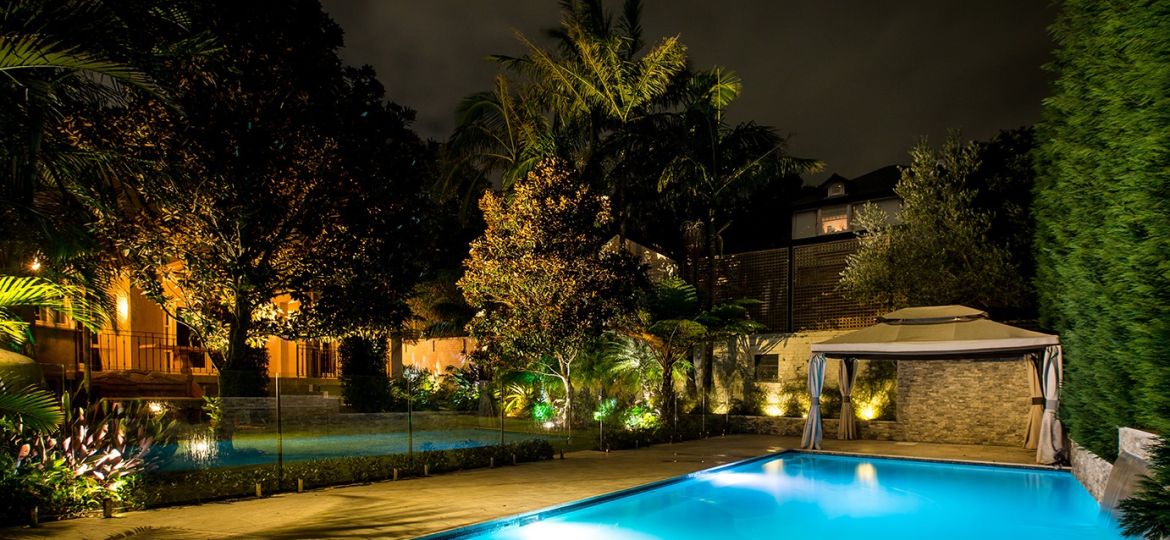
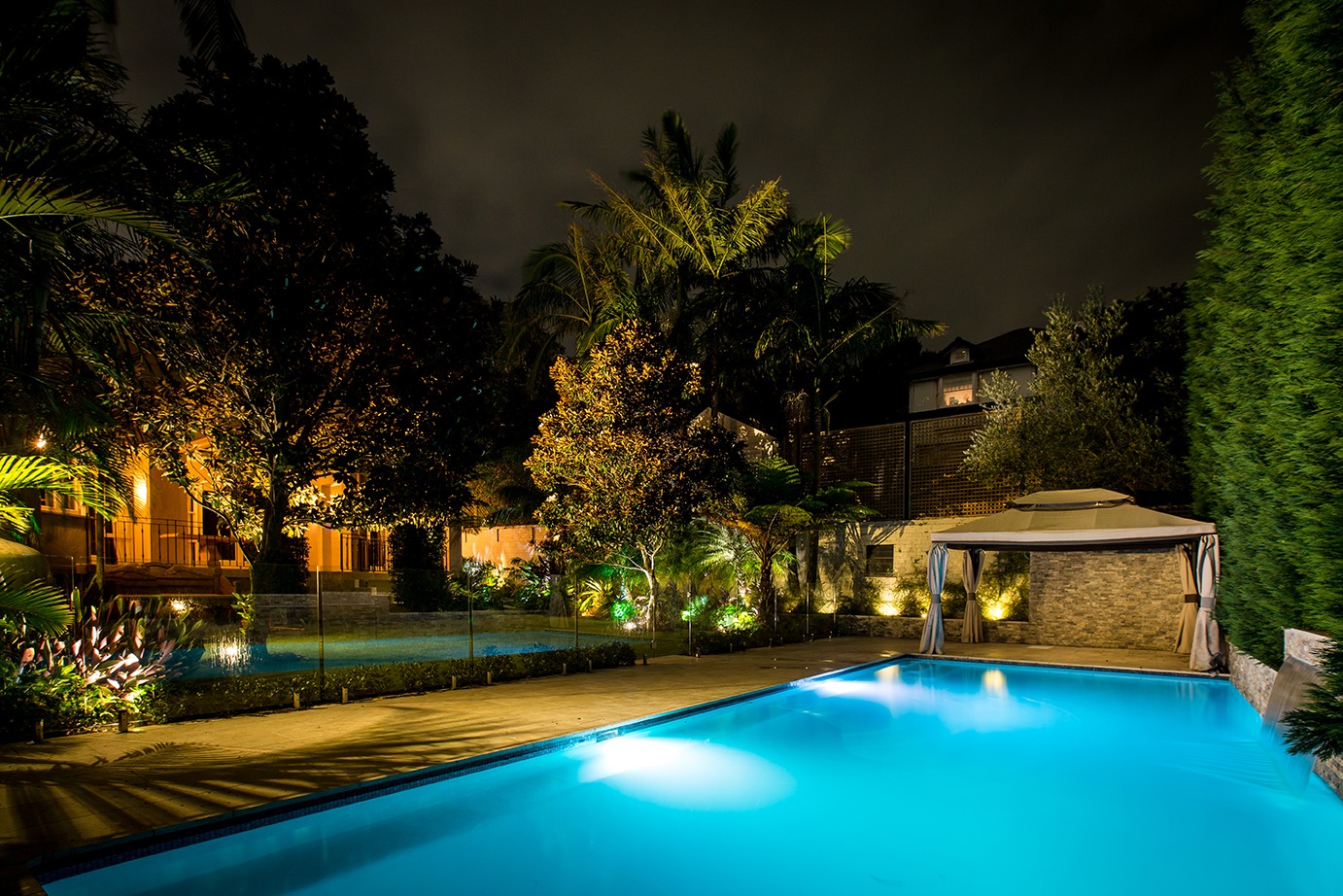
Architectural outdoor lighting in a suburb like Vaucluse, where cliffside sites, terraced gardens, and indoor-outdoor living are the basic vocabulary, should focus on letting light describe the relationship between the building, landscape, and the way people live.
The distinction between illumination as utility and illumination as narrative is what makes a lighting scheme either forgettable or part of the architecture itself.
Your home’s entrance is its first sentence
Whether the material is off-form concrete, rendered masonry, or warm timber cladding, an architect considers that surface with the same care as the floor plan behind it. Texture, proportion, shadow lines, the rhythm of piers and openings, when blasted with a wide-beam floodlight, all disappear into glare. Light it with intention and the same surface reveals depth it doesn’t show in daylight.
This is the case for wall-mounted up/down lighting along entry piers, structural columns and rendered cladding. A well-placed wedge-format wall light produces a sharp, linear graze of light that runs the height of a wall, catching every joint line and material change. The effect is architectural rather than decorative, and it looks like the building was designed to be seen this way.
The entrance sequence benefits from being read as a hierarchy rather than a single gesture:
- Low, grounded light at step level
- A mid-height wash along piers and cladding
- A soft glow lifting toward the eaves
Fixtures with integrated shielding, like hoods, eyelids, or an extended “hat” brim that throws a gentle halo against a wall face, do the quiet work of concealing the light source itself. The guest never sees the fitting; they just experience an entrance that feels considered, calm and unmistakably intentional. The difference between security lighting and architectural lighting is that one exposes, and the other reveals.
Gardens in the living room
In Vaucluse, the garden rarely reads as separate from the house, as it is usually visible through floor-to-ceiling glazing as a continuation of the living space. This means the landscape needs to hold its own visually at night, not simply exist as a dark backdrop beyond the glass.
Mature specimen trees, sculptural plantings and sandstone retaining walls each demand a different lighting logic than a flat facade. A tree’s structure is three-dimensional and irregular, so uplighting from a low, discreet ground fixture near the base throws branch shadows upward and gives the canopy a sense of scale it doesn’t have by day. Sandstone walls and timber retaining structures respond best to raking, narrow-beam light directed across the surface, which exaggerates texture through micro-shadow rather than washing it flat.
For taller canopies or features set back from the nearest power point, fixtures with adjustable swivel arms and long-reach, narrow-beam optics allow the light source to stay hidden within garden beds while still projecting cleanly into a canopy several metres up. It’s a small technical detail with a big visual payoff: the light appears to come from nowhere, and the tree appears genuinely luminous.
Colour temperature is also crucial, as a warmer white sits comfortably against sandstone, timber decking and green foliage. It reads as inviting rather than clinical, which matters enormously around an alfresco dining or entertaining zone. Cooler tones can suit a more contemporary, concrete-forward material palette, but in a garden setting, restraint toward warmth almost always photographs and feels better.
Safety considerations and lighting
Sandstone steps, curved paths, pool surrounds, sloped driveways, all made safer with tall, exposed bollards or bright post-top lanterns, right? Not quite. This approach tends to undercut everything else the scheme has achieved. A path lit too brightly, or from too high a source, creates hot spots that compete with the subtler facade and garden lighting, and worse, it can shine directly into a pedestrian’s line of sight.
The more sophisticated approach keeps wayfinding light low and downward-facing, so it grazes the walking surface rather than the eye. A flexible, bendable-stem path light can be shaped to follow the actual curve of a garden border or a run of stepping stones, producing a continuous, unbroken line of light rather than a series of disconnected pools. For driveways and more formal access paths, a slim, low-profile bollard achieves the same discretion at a slightly larger scale, present enough to guide movement, restrained enough not to compete with the architecture it leads toward visually.
Built for the cliff edge
None of this matters if the fixtures fail within a season. Vaucluse’s clifftop position means salt spray, high humidity and airborne chlorides are a constant condition. This is where lower-grade outdoor fittings begin to show their limits: pitted finishes, flaking coatings, and the brown “tea staining” that comes from iron oxidation in standard stainless steel.
The material specification has to match the site. 316 marine-grade stainless steel, with its molybdenum content, resists chloride pitting in a way ordinary 304-grade steel can’t; electroplating adds a further layer of protection against staining in exposed, wind-scoured positions. Solid copper and brass weather into a natural patina that tends to sit beautifully alongside sandstone and mature coastal planting rather than fighting it. Ingress protection matters just as much: IP68-rated fixtures are built to handle submersion and heavy irrigation around garden beds and pool zones, well beyond what a standard IP65 fitting is designed to tolerate.
The outdoor lighting Vaucluse needs
Bondilights, designed and manufactured in Australia for more than fifteen years, has a range built specifically for the demands of harbourside and clifftop properties. Our electroplated 316 marine-grade stainless steel and solid copper construction, IP68 waterproofing, low-voltage plug-and-play wiring, and long-life NICHIA LED engines are engineered to run cool and UV-free for decades of nightly use.
For architecturally considered Sydney homes, we offer products that disappear into the design and let the architecture and landscape take the credit after dark.