
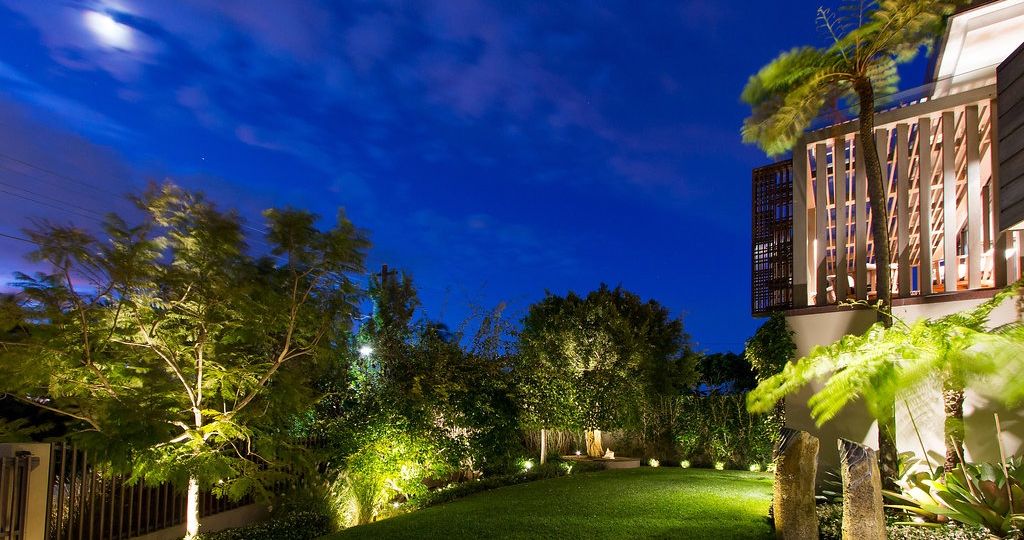
There has been something of a rewriting of the rules of outdoor lighting. The old approach of bolting a handful of high-wattage floodlights to the eaves and calling it “security lighting” no longer fits a home designed around indoor-outdoor connection. Inviting is the goal, rather than blinding; atmospheric rather than institutional.
This is the idea behind low-glare outdoor lighting design: outdoor spaces that feel calm, sophisticated, and comfortable to be in at night.
Brightness isn’t the same as good lighting
More light doesn’t always equal more safety. In practice, the opposite is often true. When a single unshielded fixture blasts light across a driveway or facade, the eye naturally adjusts to that brightest point in its field of view. Everything around it appears darker by comparison. This is sometimes called the “black hole” effect, and it’s one of the more counterintuitive truths of outdoor lighting: a harsh, over-lit fixture can create more hidden shadows and blind spots than a well-designed, low-level scheme.
Glare isn’t just an aesthetic complaint; it’s the result of the eye struggling to cope with extreme contrast between a bright source and a dark surrounding environment. This shows up as disability glare, which physically impairs vision, scattering light across the eye and making it harder to see steps, uneven paving, or a garden edge. It also creates discomfort, glare, a nagging sense of irritation, and eye strain that discourage people from actually enjoying their outdoor space in the evening. Neither does anything to make a home safer or more welcoming; they simply make it harder to see and less pleasant to be in.
The problem with poorly directed light
Poorly directed lighting rarely stays confined to one property. Light trespass, where a fixture’s output spills across a boundary line and into a neighbour’s windows, is a genuine source of friction between households. Excessive, blue-rich outdoor lighting is known to disorient nocturnal wildlife, interfere with the foraging habits of native mammals, and disrupt insect and bird populations.
Planning guidelines aligned with bodies such as the Australasian Dark Sky Alliance now call for fixtures with full cut-off shielding and zero upward light waste.
Why you should design in layers
The most effective outdoor lighting schemes borrow a principle from interior design: layering. Rather than one dominant light source doing all the work, a considered plan combines ambient, task, and accent lighting to build depth and guide the eye naturally through a space:
- Ambient lighting
This sets the overall mood; a soft, low-level glow rather than a wash of brightness. Bondilights’ Slim Bollard range can be custom-tailored in height, and they sit below eye level along driveways and garden edges, offering gentle illumination without ever becoming a glare source themselves.
- Task lighting
This handles the safety-critical zones: stairs, sloped paths, and uneven transitions where a shadow in the wrong place becomes a tripping hazard. The Bondilights Piccolo 20 and Piccolo 40 are built for exactly this, recessing into step risers and using “eyelid” or “hat” shields to direct light downward onto the tread while keeping the light source itself out of view. Along boundary walls and stone stairs, the LED 35° Recessed Wall Light achieves a similar effect, its angled faceplate throwing light down the wall surface rather than out toward anyone walking past.
- Accent lighting
This is where a garden gets its character. The rule here is restraint; leaving parts of the landscape in shadow makes the lit elements more striking and the space feel larger. Bondilights’ LED Garden Spike Lights, fitted with a narrow 10-degree beam lens, can pick out a specimen tree or sculptural planting with a tight column of light rather than a wide, spilling flood. These fixtures lend themselves to more atmospheric techniques, like grazing a textured sandstone wall to bring out its surface, silhouetting a well-shaped shrub against a lit backdrop, or mirroring a lit planting across the surface of a pool at night.
Engineering the glare out
There’s a reason why the Bondilights’ outdoor range uses recessed LED chips, angled faceplates, and physical shields such as hoods and eyelids; they intercept horizontal light rays before they ever reach eye level.
Materials matter too, as fixtures built from 316-grade stainless steel, solid brass, and solid copper are engineered to withstand coastal salt spray and harsh Australian UV without corroding or discolouring, so the lighting continues to perform and look as intended for decades.
Colour temperature plays its own role in comfort. Cool white light above 5000K scatters more readily in the eye and reads as stark against natural materials like timber and sandstone. Warm white tones between 2700K and 3000K feel far more inviting, though standard warm white can dull the green tones of garden foliage. We like blending warm white with green LEDs, specifically to keep foliage looking vibrant at night without sacrificing that warm, residential feel.
Making the most of low glare outdoor lighting
Good lighting makes gardens usable after dark, and when done with efficient LED technology, it cuts energy use dramatically compared with old halogen systems. Good lighting design reveals a home’s best features while staying out of the way itself.
Let the team at Bondilights help you create a garden and facade that feel considered, comfortable, and ready to be enjoyed the moment the sun goes down today.