
It’s a common instinct: if you want your entrance to feel safe, whack up a big bright light and call it done. A single, unshielded, high-wattage light source, however, actually works against you.
When your eyes catch a harsh, direct light like that, your pupils contract almost instantly to protect your retinas. That’s a normal biological response, but it comes at a cost: your night vision drops, and everything around that bright spot becomes harder to see. This is called the “black hole effect”: the areas just outside the beam of a glaring light look pitch black by comparison, even darker than they would under gentler, more even lighting.
Instead of a safer entrance, you end up with a blinding hotspot and a bunch of shadowy pockets right where you’d want visibility most. The fix isn’t more lumens; it’s smarter placement. Good entry lighting spreads soft, even illumination across the areas people walk through, keeps the light sources themselves shielded from view, and avoids sending glare straight into anyone’s eyes.
Why you should use warm light in front entrance lighting
Colour temperature has a real, immediate effect on how a space feels. Warm white light (roughly in the 2700K to 3000K range) reads as cosy and welcoming, the kind of glow that makes a home look lived-in and inviting from the street.
Cooler, blue-tinted light above 5000K tends to feel clinical, more like a car park or hospital corridor than a front porch. If you want your entrance to say “come on in” rather than “please wait here,” warm white is almost always the way to go.
The three layers of outdoor entrance lighting
Professional lighting designers tend to break entrance lighting into three layers:
- Wall lighting for the architecture
- Pathway lighting for safe footing
- Garden or accent lighting to tie the whole scene together
Used on its own, each layer looks a bit flat, but combined, they create depth, with a layered, considered look that makes a home stand out at night. Let’s break them down.
Layer one: Highlighting the walls and façade
Start with the vertical surfaces, like the walls, columns, and cladding that frame your front door. Washing these surfaces in soft light does two things: it defines the shape of your entrance in the dark, and it shows off the texture of brick, stone, or timber in a way flat overhead light never will.
Fixtures like the Bondilights LED Wedge Wall Light Up & Down or LED Cube Wall Light Up & Down are built for exactly this. When mounted either side of the entry door, they throw light both upward and downward along the wall, creating a balanced glow that frames the doorway nicely. If you’ve got a narrower path flanked by walls or a stairwell, the Bondilights LED 35° Recessed Wall Light is worth considering, as it’s angled to send light straight down onto the ground, so you get illumination without any glare shining back at eye level.
Layer two: Getting people safely to the door
This is the layer that matters most for pure safety. Steps, uneven pavers, and garden edging are the things people trip on, and they’re exactly what pathway lighting needs to reveal clearly.
The Bondilights LED Bollard Slim and LED Path Light are good options for straight, low-profile lighting along a walkway. Instead of lining them up in a perfectly straight symmetrical row (which can look a bit stiff), try staggering them along either side of the path. It reads as more natural and actually guides the eye forward in a more intuitive way.
Steps deserve special attention, since that’s where a lot of trips happen. Rather than shining light into someone’s face as they walk up, the goal is to light the tread (the flat part you step on), while leaving a bit of shadow on the riser below to make each step visually distinct. Compact fixtures like the Bondilights Piccolo 20 or Piccolo 40, fitted with a hat, hood, or eyelid shield, are designed to do just this: they wash light down onto the stair surface without ever throwing a glare source into your line of sight.
Layer three: Framing the entrance with the garden
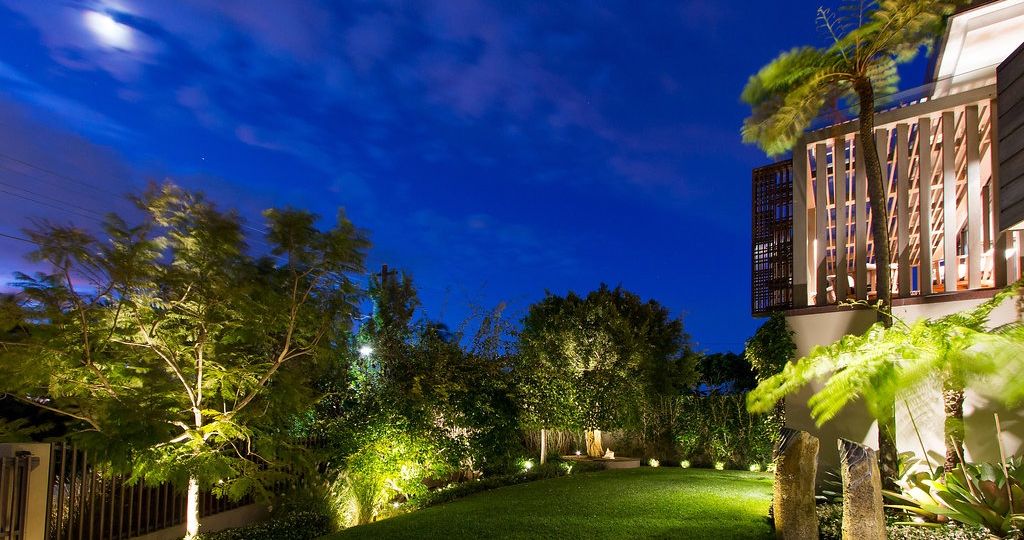
An entrance can look fantastic architecturally and still feel incomplete if the garden around it disappears into total darkness. This last layer is about pulling the landscape into the picture, so the whole scene feels connected rather than like a spotlit doorway floating in a black void.
Ground-mounted spike fixtures, like the Bondilights High-Powered LED Garden Spike Light, are great for uplighting a specimen tree, a feature shrub, or a stretch of stonework near the entry. If your garden changes with the seasons, the Bondilights LED Pivot Light is a handy option, since its swivel-arm mount lets you re-angle the beam as plants grow or garden beds shift over time. For a subtler finishing touch, low-voltage LED Strip Lights tucked along a retaining wall, under a step overhang, or into a soffit edge add a soft line of continuous light that quietly ties the whole entrance together.
Speak to Bondilights for more front door lighting ideas
One major tip our team will give you: none of this matters much if the fixtures don’t survive outside. Outdoor lighting deals with rain, humidity, temperature swings, and salt air that can corrode cheaper metals fairly quickly. Bondilights fixtures are built from 316 marine-grade stainless steel, solid copper, or solid brass, which hold up far better against corrosion than standard outdoor light housings.
Many are rated IP68, the highest ingress protection standard going, meaning they’re built to handle sustained water exposure rather than just the occasional light drizzle. As the LED engines run cool and efficiently, they’re gentle on nearby plants, safe around kids and pets, and typically rated for tens of thousands of hours of use. Once it’s set up properly, it’s largely a set-and-forget system, and the experts at Bondilights are here to help you get it all sorted today.